Recent Projects
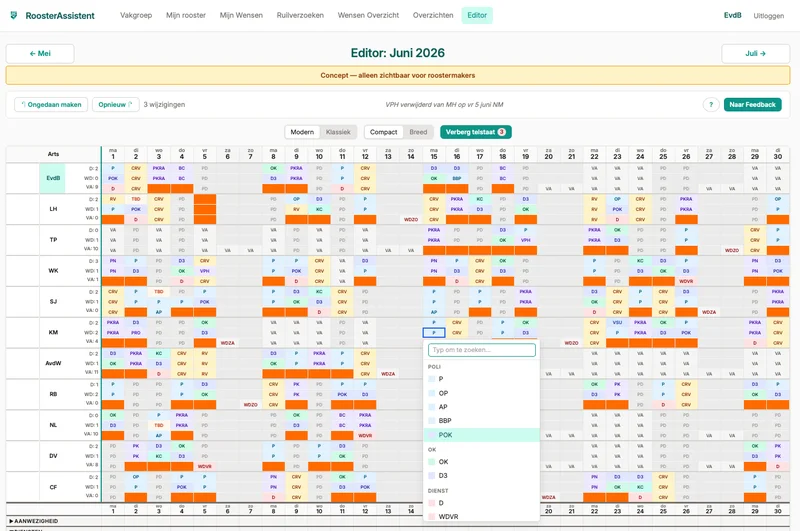
Scheduling Assistant
A medical department spends approximately 8 hours per month manually scheduling 12 doctors across operating theatres, outpatient clinics, shifts, and external locations. The Scheduling Assistant reduces this to around 30 minutes of review.
The principle is simple: work iteratively until all rules are clear and measurable. Hard constraints such as rest periods and minimum staffing. Softer constraints such as preferences and fair distribution. The unspoken rules you only notice once you see them.
During onboarding, we work through the PDCA cycle together with the planners until all rules are made explicit. An AI interviewer asks targeted questions, produces a draft schedule, and the planner provides feedback. The cycle continues until there is a clear understanding of the system.
Result: 8 hours of manual work reduced to approximately 30 minutes of review per month.
Ponder
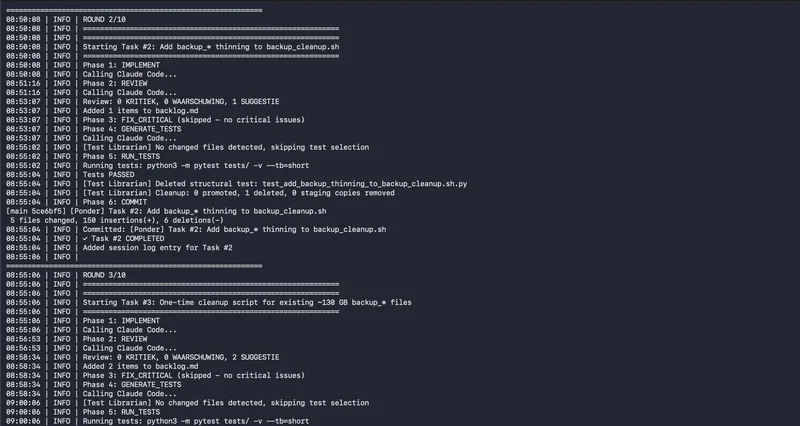
Ponder breaks complex tasks into parts small enough to complete reliably. It functions as a conductor, decomposing tasks into atomic units, executing them through specialised AI workers, and reviewing, testing, and committing each result.
Each worker operates with a clean context and explicit instructions. There is no shared memory and no reliance on assumptions from earlier steps. If a task cannot be completed within 15 minutes, it is considered too large. Ponder divides it further.
The result is work that can be brought into production in a controlled and traceable manner.
The underlying principle is simple: if an AI loses track of its task, the scope was too broad.
St. Elmo’s Fire
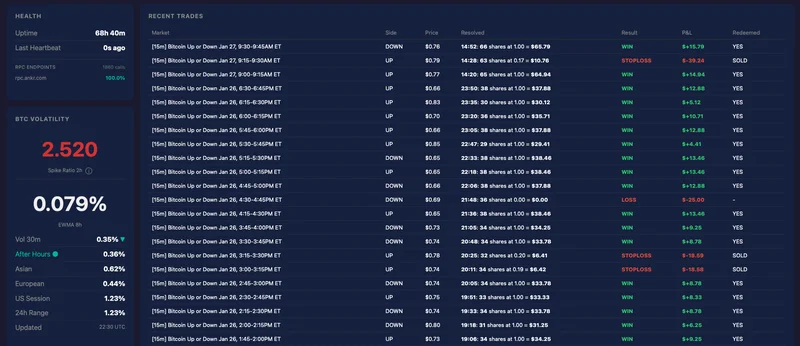
An automated trading system for Bitcoin prediction markets on Polymarket.
Three specialised AI roles operate together, making decisions on hundreds of trades per day, based on short-term price movements.
Real capital. Real consequences.
After 3,500 trades, the win rate stands at 85.6%.
Data integrity and safety rules are treated as non-negotiable.